
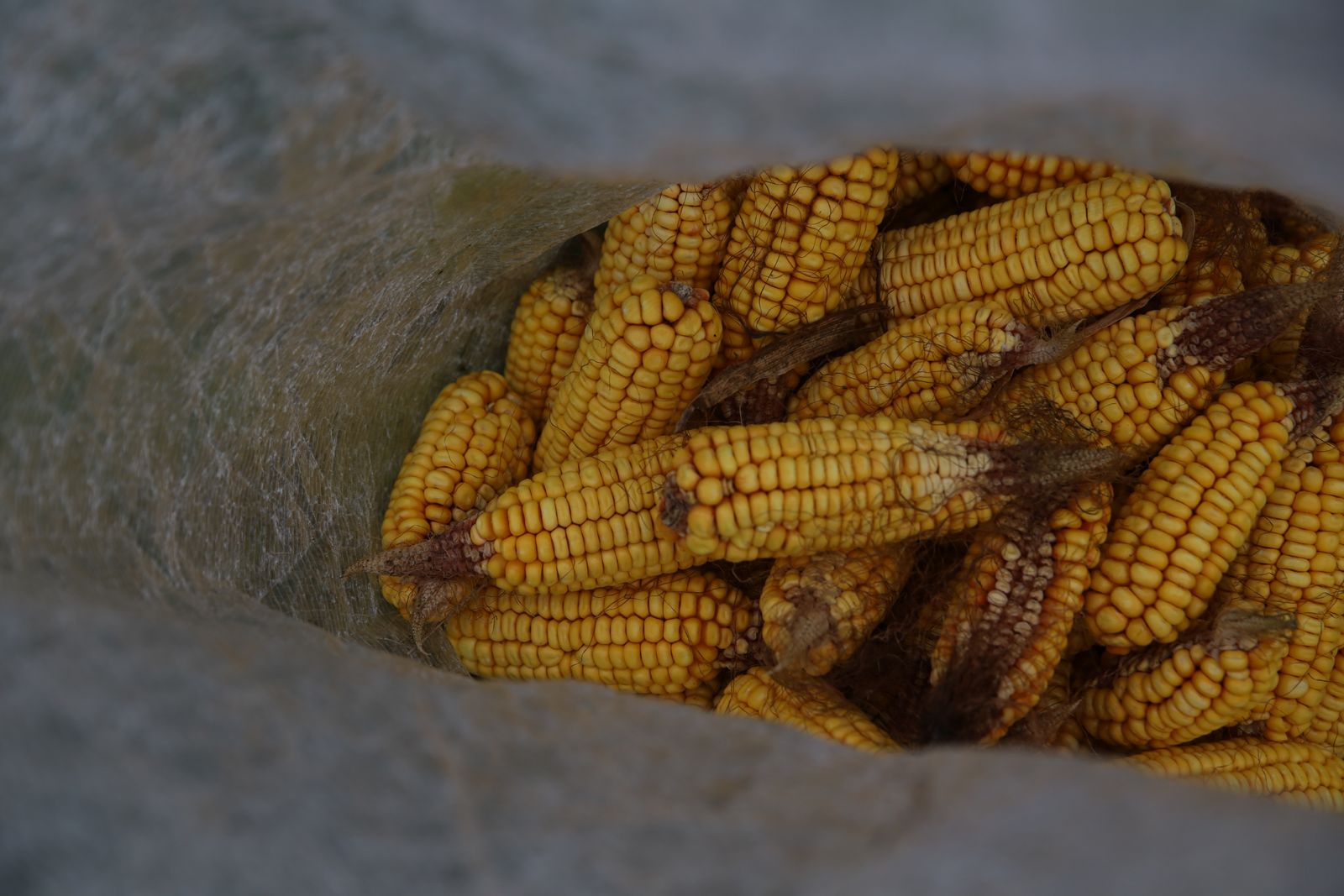
In April 2026, maize producers around Niakara, in central-northern Côte d’Ivoire, were selling their grain at 100 to 110 FCFA per kilogram, half of what the same weeks usually pay them (AIP, April 2026). In a year like this, input credit does not get repaid. Unless the program was designed for a year like this.
Key takeaways
- Input credit fails at collection, not at signature. Side-selling and harvest-time price drops do the damage.
- Contract the industrial buyer before planting, volume and price agreed. The off-take contract is the real collateral.
- Finance the campaign against firm purchase orders, and put base fertilizer on supplier credit. The distributor’s own cash stays out of the field.
- Storage guards the margin: the harvest price and the industrial demand window are two different markets.
Input credit fails at collection, not at signature
Every input distributor on the corridor has lived this cycle. Packs of seed, fertilizer and crop protection go out on credit in May and June. Harvest comes in November. Then the grain leaves the farm at whatever price the first trader offers, and the credit stays behind. The contract was signed in an office; the default happens at the roadside, one bag at a time.
The year 2026 shows how brutal the exposure is. Around Niakara, producers reported farm-gate prices of 100 to 110 FCFA per kilogram in April, against 200 to 225 in a usual year, because the buyers who normally come from Mali and Burkina Faso did not show up (AIP, April 2026). Nothing in those producers’ fields changed. Their repayment capacity was cut in half by a market they never see.
Post-harvest handling adds its own tax: landscape studies put smallholder losses between 30 and 50 percent of production across sub-Saharan Africa (FAO and FCDO reviews). A credit file that ignores these two forces is not a credit file. It is a donation with paperwork.
Read the price ladder before you write the credit
Follow one kilogram of maize through Côte d’Ivoire in 2026. At the farm gate in Niakara in April: 100 to 110 FCFA. In Abidjan at the end of June: 300 FCFA wholesale, 500 FCFA retail for yellow maize (Sika Finance market data, 27 June 2026).
A city price does not trickle down to the producer. It crosses a chain: collector, transporter, storer, wholesaler, each taking a margin and a delay. The producer who sells at harvest sells at the bottom of that ladder. The operator who can hold grain until the industrial demand window sells near the top. Repayment capacity is decided by when the grain is sold and to whom, far more than by the harvest itself. Any input credit program that does not answer those two questions has already chosen default.
The design that came back at 96 percent
The founder of C2A ran a maize contract-farming program in northern Côte d’Ivoire built on exactly these principles: 600 input packs placed on credit over 600 hectares, a contractual delivery obligation of about 2.4 tonnes per hectare, and 1,396 tonnes collected out of 1,455 contracted. A 96 percent collection rate, in an environment where grain sold outside the contract is the classic way these programs die.
Five design choices made the difference:
- Industrial off-takers signed before planting. Feed millers and grain processors committed on volume and price before a single pack left the warehouse. Demand was never the question; contracted demand was.
- Quality treated as a gate, not a surprise. Independent laboratory analyses against each buyer’s specification, aflatoxin included. Grain that meets the feed industry’s standards has more than one buyer; grain that does not has none.
- Bank pre-financing as advances on purchase orders. The campaign was funded against the buyers’ firm orders, not against the distributor’s treasury. No firm order, no exposure.
- Base fertilizer on supplier credit, repaid from crop proceeds. The heaviest cash outlay of the pack never became a cash outlay.
- Scale discipline. Extension beyond the pilot surface only once the field supervision ratio follows. An extra hectare without an extra supervisor is an extra hectare of losses.
The model earns twice on the same hectare: margin on the pack placed, margin on the grain collected. That second stream is what makes the first one recoverable.

Storage is the guardian of the window
On that same program, physical losses were brought from 5.3 percent toward a 2 percent target by contracting third-party storage capacity. Storage is treated as a cost line in most credit files. It is the opposite: it is the instrument that lets the program sell in the industrial demand window months after harvest instead of dumping grain in November, and it is the difference between the farm-gate price and the wholesale price staying with intermediaries or funding the chain that produced the grain.
The producer is not the loser in this design. A contracted price agreed before planting, a buyer who shows up, inputs delivered on time and a collection team at harvest: in a year like 2026 in Niakara, that package is worth more than any subsidy.
Where C2A comes in
C2A CONSULTING ET TRADING SARLU structures input credit and contract-farming programs across West Africa: qualification of industrial off-takers, credit and pack design, purchase-order financing with banks, quality protocols and storage partnerships. We have run this model in the field, from the first purchase order to the last truck weighed. If your network finances campaigns and waits for the grain to come back, let us look at the design before the next planting window.
Structure credit that comes back
Book a working session on your input credit or contract-farming program, or write to us.